The Context
Luxury residential management depends on a paradox: residents expect immediate, high-touch responsiveness, but the back-office labor required to provide it is increasingly expensive and difficult to scale. In high-end buildings, a tenant inquiry is rarely just a data point; it is a request for comfort, safety, or convenience. Whether it is a maintenance emergency at 2:00 AM, a question about lease terms during a relocation, or a request for amenity access, the quality of the interaction defines the brand value of the property.
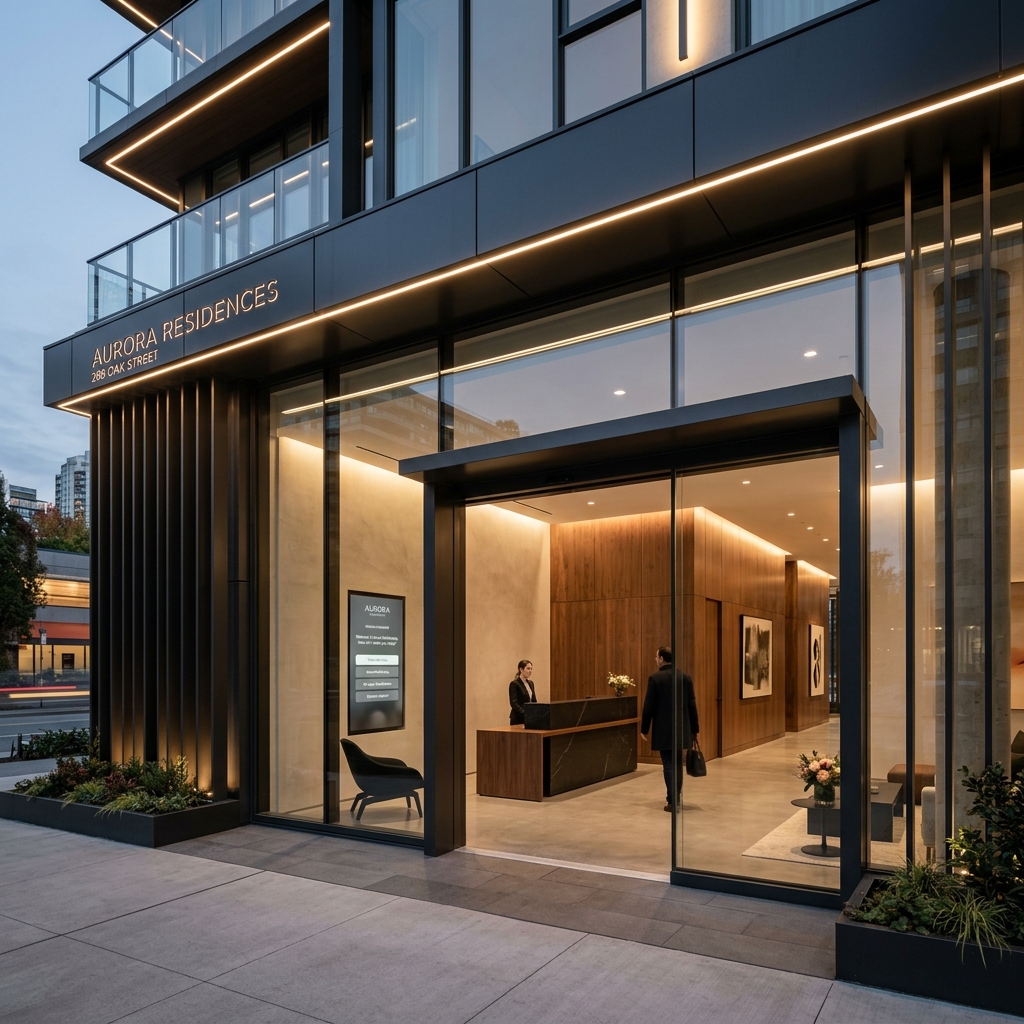
Aurora Residences, a developer of premium multi-family assets, faced a challenge common to the sector. Their property managers were overwhelmed by a high volume of repetitive administrative tasks—dispatching vendors, following up on lease documentation, and answering basic building questions—which left them little time for high-value community building and strategic asset management. The existing "concierge" solutions were either one-way portals that residents disliked or simplistic chatbots that failed when faced with any degree of contextual complexity. The goal was not to replace the human touch, but to provide a digital concierge capable of handling execution while keeping managers in a position of authority.
The Mandate
The brief was to design and deploy an agent-assisted tenant services platform that could function across multiple high-end buildings. This was not a "chatbot" project. It was an operational transformation. The system needed to connect to the central Property Management System (PMS), understand the specific rules and vendor contracts of each building, and orchestrate actions autonomously—such as creating work orders, scheduling viewings, and validating lease applications—while maintaining an auditable trail for the management team.
We built the system around three core service pillars: Resident Intelligence, Maintenance Orchestration, and Lease Lifecycle Automation. Each stage of the tenant journey was mapped to identify where agents could take full ownership (low-risk, high-frequency) and where they should act as assistants to a human manager (high-risk, high-judgment). Reliability and "concierge-grade" tone were non-negotiable; if the agent couldn't resolve an issue with 100% confidence, it had to escalate immediately with full context.
What We Built
1. The Digital Concierge Agent
We deployed a multi-channel agent (accessible via web and mobile) that serves as the first point of contact for all resident needs. Unlike standard IVR or FAQ bots, this agent has a "memory" of the resident's history, the building's specific amenities, and current operational constraints. If a resident reports a leak, the agent doesn't just provide a list of numbers; it identifies the severity, checks the building's specific plumbing contractor list, and generates a pre-filled work order in the PMS for approval.
The agent was trained on thousands of pages of building-specific documentation, from HOA rules to HVAC maintenance manuals. This allows it to provide precise answers about parking regulations, pet policies, or guest access without needing to ping a busy property manager. It functions as a single, consistent source of truth that is available 24/7, ensuring that residents in different time zones or with varying schedules receive the same level of service.
2. Maintenance Orchestration Engine
One of the most significant friction points in real estate is the "maintenance loop." From the initial report to final vendor sign-off, there are typically 6-10 manual coordination steps. We designed an agent to orchestrate this entire lifecycle. When a resident submits a request, the agent categorizes the problem, assigns a priority level based on building safety protocols, and notifies the appropriate internal or external maintenance team.
Crucially, the agent stays "on the case." It follows up with the resident if a vendor hasn't checked in, updates the expected arrival time based on contractor feedback, and captures feedback once the work is done. By handling the 90% of coordination that doesn't require complex judgment, the agent allows the building's facilities manager to focus on inspecting quality and managing major capital projects.
3. Lease Lifecycle & Document Automation
Leasing and renewals are traditionally document-heavy and error-prone. We implemented agents to handle the ingestion and validation of lease applications and renewal documents. The agent can parse utility bills, identification, and proof of income, checking them against the building's specific credit and background criteria. It identifies missing information and follows up with applicants via their preferred channel, reducing the "time-to-signature" by several days.
For existing tenants, the agent proactively manages the renewal cycle. It summarizes upcoming lease changes, answers questions about renewal incentives, and prepares the legal documentation for digital signature. By making the renewal process frictionless and conversational, Aurora Residences saw a measurable increase in retention rates in their pilot buildings.
Why Agents Worked Here
Real estate operations are messy. They involve heterogeneous data, legacy software, and unpredictable human requests. Standard automation fails because it cannot handle the "edge cases" that are standard in building management—like a tenant who uses local slang to describe a broken appliance or a vendor who provides an update as a voice note. Our agentic approach succeeded because it prioritizes **Context** and **Orchestration**.
The agents don't just "talk"; they "do." By connecting directly to the property's stack (Yardi/RealPage), the agents have the authority to pull data and push actions. We focused heavily on the **Governance Wrapper**: every autonomous action is logged, and high-impact actions (like dispatching an expensive emergency plumber) require a one-click human "seal of approval" through a manager dashboard. This creates a "Managed Autonomy" model that property owners trust.
Operational Outcome
The implementation across Aurora Residences' initial portfolio of 1,500 units led to a transformative shift in operational efficiency and resident satisfaction. Resident response times for non-emergency inquiries dropped from an average of 4 hours to under 30 seconds. Maintenance coordination overhead was reduced by 60%, as managers were only involved in final sign-offs and complex escalations.
From a commercial perspective, the "Lease-to-Live" cycle was shortened by 24%, meaning units stayed vacant for less time between tenants. Staff turnover among property managers also decreased, as they were freed from the "administrative grind" and able to spend more time on-site, improving the physical asset and resident community. This case proves that AI agents don't have to be "impersonal"; when designed with discipline and context, they can provide a higher level of personalized service than a traditional, overburdened human staff could ever achieve.
Future Scalability
As Aurora Residences expands, the agentic layer serves as a "Building Template." Launching a new asset no longer requires hiring a full administrative staff on day one. Instead, the building's specific rules, vendors, and amenities are "fed" to the agent layer, which provides immediate, day-one concierge capability. This allows the developer to scale their portfolio without a linear increase in headcount, fundamentally changing the unit economics of high-end property management.